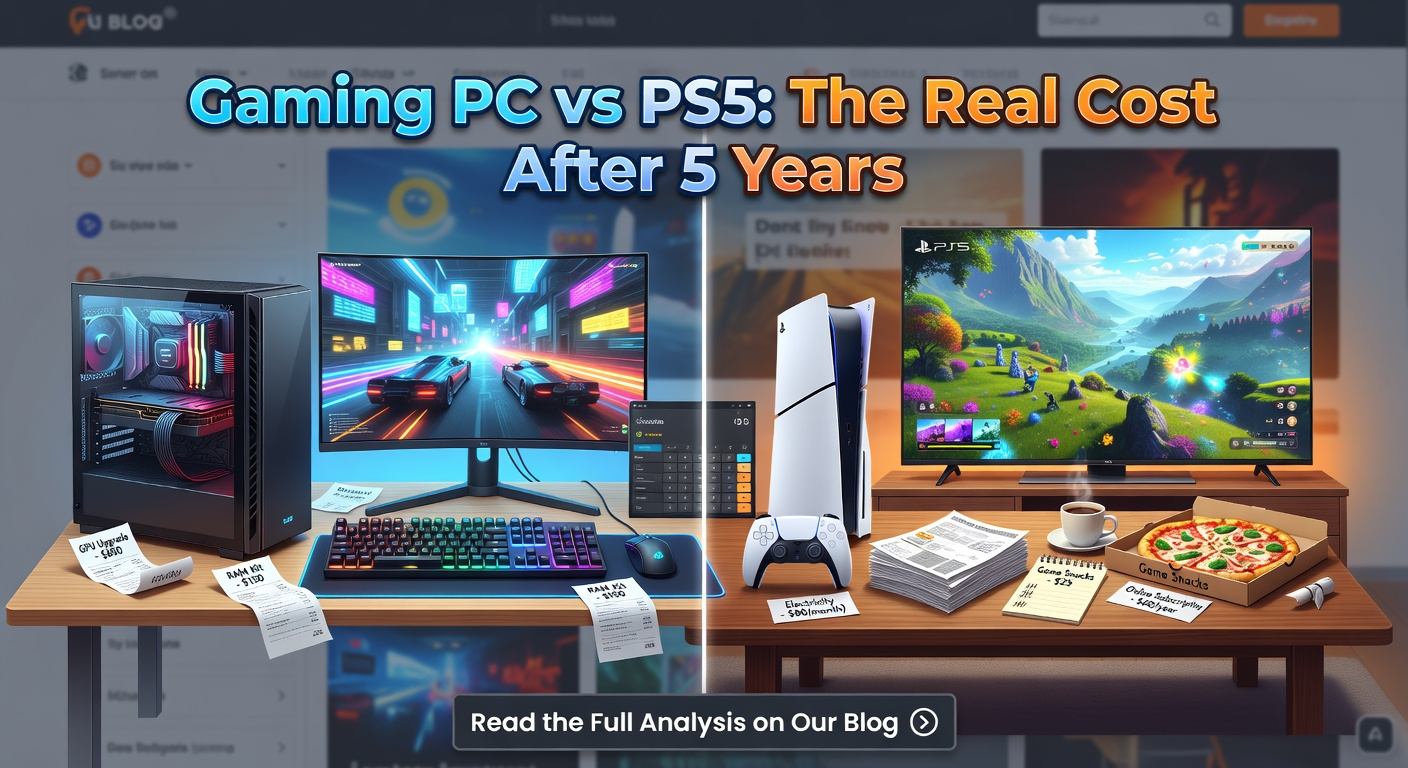
You’re standing at a crossroads: grab a PS5 console and start playing tonight, or invest in a gaming PC that promises more power, more flexibility, and more everything.
At first glance, it looks simple: consoles are affordable, and PCs are expensive. But five years in, that story starts to change, and sometimes in ways that catch you off guard. This isn’t about which is “better.” It’s about where your money actually goes and how it stacks up. Over time, the cost difference depends on how you play and what you prioritise.
The Upfront Illusion
This is where consoles win you over. A PS5 feels like a clean deal. One price, one box, plug it in, done. A gaming PC, on the other hand, seems like a commitment. You’re not just buying a machine, you’re choosing parts, performance tiers, and upgrade paths. And yeah, the price climbs fast.
But here’s the catch: that low upfront console price is heavily subsidised by what comes later. Meanwhile, the PC front-loads most of its cost.
And historically, consoles were supposed to get cheaper over time. That’s not really the case anymore. Prices are holding or even rising, which chips away at that early advantage. So yeah, consoles still feel cheaper upfront. But that’s only the opening move.
Subscription Creep
This is where the cost math quietly shifts. On console, online multiplayer isn’t free. For most games, outside a handful like Fortnite, you need an active subscription just to play with friends. PlayStation Plus Essential runs about ₹5,000 a year. Over five years, that’s ₹25,000 before you’ve bought a single game.
On PC, there’s no such paywall. You pay for your internet connection, that’s it. Want to jump into Call of Duty online? You just play. No extra fee, no monthly charge.
Yes, services like Xbox Game Pass for PC exist, and they’re great if you want them. But they’re optional. You’re never forced to subscribe just to access basic multiplayer. That’s why subscription fees are one of the highest hidden costs of console gaming. It’s subtle and normalised, but it adds up fast.
Where PC Starts Pulling Ahead
This is the part nobody tells you upfront. Console games tend to stay expensive longer. Big releases launch high, and even older titles can hold their price surprisingly well.
PC pricing is more flexible in a good way. It has sales everywhere, seasonal drops, and bundles. Free games are available regularly through promotions and platforms. Over time, your library grows faster and can also cost less depending on your choices.
And if you’re the kind of player who buys more than just a couple of games a year, this becomes the defining cost difference.
Even general comparisons agree. PCs tend to offer lower game costs and more pricing flexibility over time. It’s not obvious in month one. But by year three or four, you feel it.
The “Optional” PC Costs
Now let’s talk about the PC side, the part people tend to ignore. Because yes, a gaming PC opens doors. But it also opens your wallet. You start with the basics, and then suddenly you’re eyeing a mechanical keyboard because “it just feels better.” Then a proper mouse. Then, a high refresh rate monitor, because 60Hz suddenly seems wrong.
None of these are required. But once you experience them? It’s hard to go back. This is the paradox of PC gaming. More freedom means more temptation, and more temptation means more spending. Still, these are upgrades you choose, not fees you’re locked into, which makes a big psychological difference.
Power Consumption Costs
Gaming PCs can use more power than consoles, especially with high-end components. Over time, this adds to your electricity bill, which becomes a noticeable part of the long-term cost. Gaming PCs can use more power than consoles, especially with high-end components. Over time, this adds to your electricity bill, which becomes a noticeable part of the long-term cost.
The 5-Year Reality Check
Here’s how the long-term costs start to balance out. PCs also evolve. You can upgrade parts gradually instead of replacing everything at once.
Consoles? You ride the generation out, and then jump again. And with rumours and trends pointing toward pricier next-gen systems like the eventual PS6 console, that jump might be bigger than expected. So the trade-off becomes this: PC is steadily spending with flexible upgrades, while the console starts low but resets later. Neither is perfect. It just depends on how you prefer to spend.
Upgrade vs Full Replacement
This difference becomes clearer over time. With a PC, you can upgrade individual parts like the GPU or RAM instead of replacing the entire system. Consoles don’t offer that flexibility. You typically use them for a full generation and then replace them entirely.
Conclusion
After five years, a clear pattern starts to show. The console that felt affordable at first starts looking less so over time. Subscriptions, full-price games, and next-gen upgrades all stack up. The PC that felt expensive? It settles in. Your costs become predictable, and your system evolves instead of resetting.
So what’s the real difference? It comes down to control. With a console, you pay for convenience. With a PC, you pay for flexibility.
Disclaimer
The content on this blog is for informational and educational purposes only. While we aim to provide accurate information, we can’t guarantee its completeness or accuracy. The views expressed are those of the authors and may not reflect those of the blog.
References:
https://medium.com/%40anurooopadevds/total-cost-optionality-and-ecosystem-control-a-pc-vs-console-comparison-2721c4b61d19
https://www.techradar.com/gaming/consoles-pc/next-gen-playstation-and-xbox-consoles-may-use-much-stronger-hardware-and-im-worried-well-get-premium-prices-without-a-premium-experience
https://www.olx.in/blog/electronics-appliances/gaming-pc-vs-console/
https://www.techradar.com/computing/gaming-pcs/gamers-lets-not-pretend-ps-plus-and-xbox-game-pass-multiplayer-subscriptions-are-okay-theyre-exactly-why-pc-gaming-is-arguably-cheaper-in-the-long-term