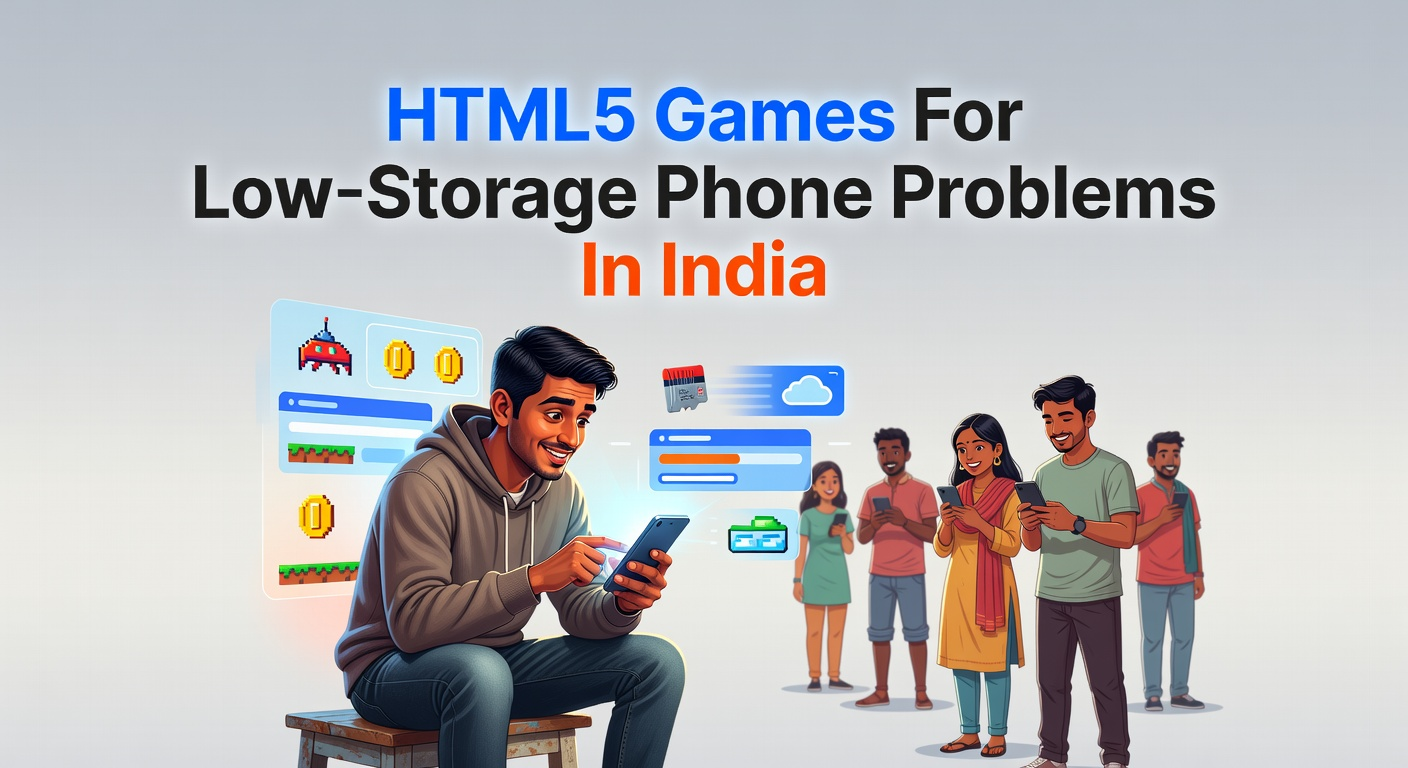
HTML5 Games For Low-Storage Phone Problems In India

You know that moment when you’re about to install a new game

It’s frustrating, and way too common. In India, a lot of players are still on 32GB or 64GB phones, juggling apps, photos, WhatsApp forwards, and then modern games ask for 2GB like it’s nothing. That’s exactly where HTML5 games start to feel less like a niche and more like a smart, practical solution. They don’t fight your phone’s limitations because they work around them.

According to market reports, a large share of smartphone users in India still use budget devices with limited storage, which makes this issue very common.

Instant Play Means You Actually Start Playing

There’s something refreshing about tapping a game and just playing. It’s kind of freeing to have no installs, updates, or permission screens asking for half your phone. That’s the core magic of instant play.
With no download games, you skip the entire waiting process. You open a link, the game loads in your browser, and you’re in within seconds. It feels closer to opening a YouTube video than installing an app.
And here’s the thing, this changes how you try games. You’re more willing to experiment. You can try five different games in ten minutes and leave them if you don’t like them. It’s simple to get into, but staying consistent is where most players struggle, and HTML5 games don’t pressure you into that commitment.

Zero Download No Storage

Let’s be real, most of us have deleted apps just to make space for a game we weren’t even sure we’d like. That cycle gets old fast. HTML5 games flip that completely. They don’t live on your phone the way traditional apps do. Instead, they run through your browser, using browser-based loading and caching. So your storage stays mostly untouched.
And no, this doesn’t automatically mean “cheap” or “low quality.” It just means the delivery is smarter. The game isn’t sitting permanently on your device; it shows up when you need it and disappears when you’re done. You don’t really appreciate how freeing that is until you stop seeing storage warnings every other day.

Cross-Platform Games That Feel Flexible

An underrated win is that cross-platform games in the HTML5 world just work. There’s no ecosystem lock-in and no ‘this version is only for Android’ limitation. If your device has a browser, you’re good. Phone, tablet, laptop – doesn’t matter, you can switch devices without thinking twice.
And in India, where device sharing is still very common (especially in families), this flexibility matters more than people admit. You’re not tied to one screen or one install. It’s gaming that adapts to your situation. Not the other way around. And once you get used to that freedom, going back to single-device games feels a bit restrictive.

Built for Real-World Conditions

Not everyone is running the latest flagship phone with blazing-fast 5G, and game developers are starting to recognise that. HTML5 games are generally lighter, faster to load, and less demanding on both hardware and data. That makes them perfect for everyday scenarios, whether you’re playing during a commute, waiting in a queue, or just sneaking in a quick session between tasks.
They’re designed to run smoothly on modest devices and average connections, and that’s the key difference. Because what’s the point of a visually stunning game if it lags, crashes, or eats your data plan alive? HTML5 games focus on playability first, which, in most real-world situations, is exactly what you need.
For example, lightweight HTML5 games can run smoothly even on entry-level smartphones with basic hardware.

Casual Gaming Is Growing

Gaming habits are changing. Not everyone wants to grind for hours or commit to massive downloads anymore. More and more players just want quick, easy fun. That’s where HTML5 games shine. They fit perfectly into this “play for a few minutes and move on” lifestyle. Platforms built around browser gaming are leaning hard into this idea of short sessions, fast loading, and instant access. And in a market like India, where time, data, and storage all matter, this approach just makes sense.
Recent trends show that more players prefer short, quick gaming sessions instead of long, time-consuming gameplay.

Conclusion

HTML5 games aren’t trying to compete with massive, high-end mobile titles, and they don’t need to. They solve a different problem entirely by removing friction, downloads, and storage issues. In a country where millions of gamers are working with real constraints like limited space, shared devices, and the average internet connectivity, that kind of simplicity isn’t just convenient. It’s precisely what makes gaming accessible in the first place.

Disclaimer: The content on this blog is for informational and educational purposes only. While we aim to provide accurate information, we can’t guarantee its completeness or accuracy. The views expressed are those of the authors and may not reflect those of the blog.

References:
https://genieee.com/blogs/the-rise-of-html5-games/
https://www.construct.net/en/blogs/construct-official-blog-1/html5-games-faster-native-786
https://medium.com/@EpicOnlineGames/html5-games-the-near-native-performance-comeback-310ef40521a7
https://www.juegostudio.com/blog/emerging-trends-for-modern-html5-game-development-in-2025
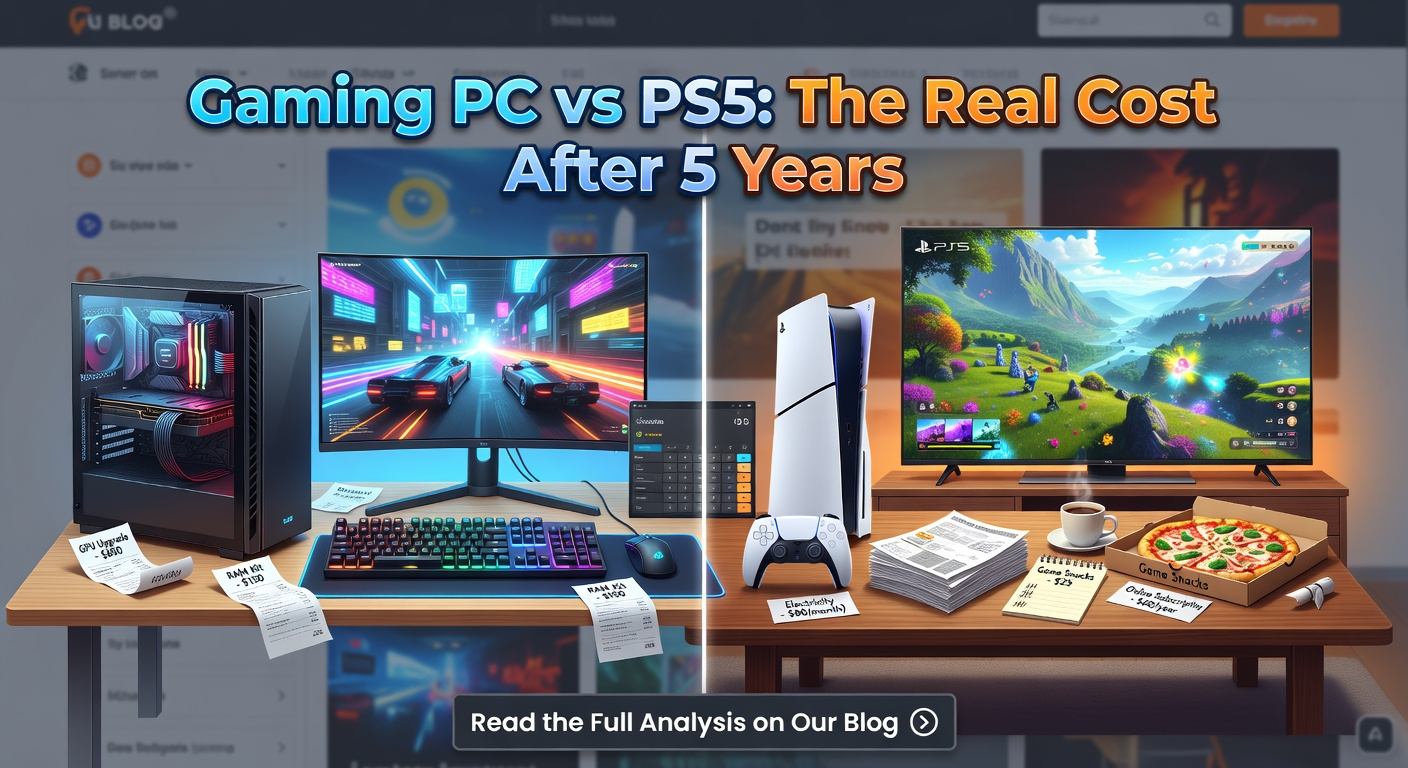
Gaming PC vs PS5: The Real Cost After 5 Years

You’re standing at a crossroads: grab a PS5 console and start playing tonight, or invest in a gaming PC that promises more power, more flexibility, and more everything.

At first glance, it looks simple: consoles are affordable, and PCs are expensive. But five years in, that story starts to change, and sometimes in ways that catch you off guard. This isn’t about which is “better.” It’s about where your money actually goes and how it stacks up. Over time, the cost difference depends on how you play and what you prioritise.

The Upfront Illusion

This is where consoles win you over. A PS5 feels like a clean deal. One price, one box, plug it in, done. A gaming PC, on the other hand, seems like a commitment. You’re not just buying a machine, you’re choosing parts, performance tiers, and upgrade paths. And yeah, the price climbs fast.

But here’s the catch: that low upfront console price is heavily subsidised by what comes later. Meanwhile, the PC front-loads most of its cost.

And historically, consoles were supposed to get cheaper over time. That’s not really the case anymore. Prices are holding or even rising, which chips away at that early advantage. So yeah, consoles still feel cheaper upfront. But that’s only the opening move.

Subscription Creep

This is where the cost math quietly shifts. On console, online multiplayer isn’t free. For most games, outside a handful like Fortnite, you need an active subscription just to play with friends. PlayStation Plus Essential runs about ₹5,000 a year. Over five years, that’s ₹25,000 before you’ve bought a single game.

On PC, there’s no such paywall. You pay for your internet connection, that’s it. Want to jump into Call of Duty online? You just play. No extra fee, no monthly charge.

Yes, services like Xbox Game Pass for PC exist, and they’re great if you want them. But they’re optional. You’re never forced to subscribe just to access basic multiplayer. That’s why subscription fees are one of the highest hidden costs of console gaming. It’s subtle and normalised, but it adds up fast.

Where PC Starts Pulling Ahead

This is the part nobody tells you upfront. Console games tend to stay expensive longer. Big releases launch high, and even older titles can hold their price surprisingly well.

PC pricing is more flexible in a good way. It has sales everywhere, seasonal drops, and bundles. Free games are available regularly through promotions and platforms. Over time, your library grows faster and can also cost less depending on your choices.

And if you’re the kind of player who buys more than just a couple of games a year, this becomes the defining cost difference.

Even general comparisons agree. PCs tend to offer lower game costs and more pricing flexibility over time. It’s not obvious in month one. But by year three or four, you feel it.

The “Optional” PC Costs

Now let’s talk about the PC side, the part people tend to ignore. Because yes, a gaming PC opens doors. But it also opens your wallet. You start with the basics, and then suddenly you’re eyeing a mechanical keyboard because “it just feels better.” Then a proper mouse. Then, a high refresh rate monitor, because 60Hz suddenly seems wrong.

None of these are required. But once you experience them? It’s hard to go back. This is the paradox of PC gaming. More freedom means more temptation, and more temptation means more spending. Still, these are upgrades you choose, not fees you’re locked into, which makes a big psychological difference.

Power Consumption Costs

Gaming PCs can use more power than consoles, especially with high-end components. Over time, this adds to your electricity bill, which becomes a noticeable part of the long-term cost. Gaming PCs can use more power than consoles, especially with high-end components. Over time, this adds to your electricity bill, which becomes a noticeable part of the long-term cost.

The 5-Year Reality Check

Here’s how the long-term costs start to balance out. PCs also evolve. You can upgrade parts gradually instead of replacing everything at once.

Consoles? You ride the generation out, and then jump again. And with rumours and trends pointing toward pricier next-gen systems like the eventual PS6 console, that jump might be bigger than expected. So the trade-off becomes this: PC is steadily spending with flexible upgrades, while the console starts low but resets later. Neither is perfect. It just depends on how you prefer to spend.

Upgrade vs Full Replacement

This difference becomes clearer over time. With a PC, you can upgrade individual parts like the GPU or RAM instead of replacing the entire system. Consoles don’t offer that flexibility. You typically use them for a full generation and then replace them entirely.

Conclusion

After five years, a clear pattern starts to show. The console that felt affordable at first starts looking less so over time. Subscriptions, full-price games, and next-gen upgrades all stack up. The PC that felt expensive? It settles in. Your costs become predictable, and your system evolves instead of resetting.

So what’s the real difference? It comes down to control. With a console, you pay for convenience. With a PC, you pay for flexibility.

Disclaimer

The content on this blog is for informational and educational purposes only. While we aim to provide accurate information, we can’t guarantee its completeness or accuracy. The views expressed are those of the authors and may not reflect those of the blog.

References:
https://medium.com/%40anurooopadevds/total-cost-optionality-and-ecosystem-control-a-pc-vs-console-comparison-2721c4b61d19
https://www.techradar.com/gaming/consoles-pc/next-gen-playstation-and-xbox-consoles-may-use-much-stronger-hardware-and-im-worried-well-get-premium-prices-without-a-premium-experience
https://www.olx.in/blog/electronics-appliances/gaming-pc-vs-console/
https://www.techradar.com/computing/gaming-pcs/gamers-lets-not-pretend-ps-plus-and-xbox-game-pass-multiplayer-subscriptions-are-okay-theyre-exactly-why-pc-gaming-is-arguably-cheaper-in-the-long-term